Judy Masterson joined RFU in 2014 after nearly 20 years as a newspaper reporter. She likes reading about artists and scientists and hiking with her kids and grandkids.
Author Page
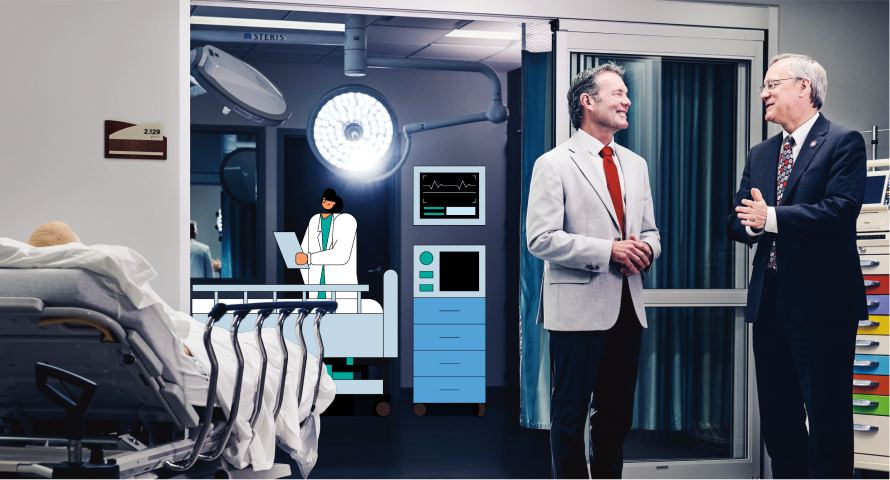
The Virtual Health System can emulate a full continuum of care. “Rosalind Franklin University’s Virtual Health System (VHS) will serve as a convening space, an innovation sandbox where partners across the region work together to train, innovate and solve some of health care’s most pressing challenges,” says Rosalind Franklin University (RFU) President Aron Sousa, MD. “We’re setting a new standard for training environments.”
When RFU formally opens its new VHS this fall, the facility will do more than transform how students learn. It will create a shared environment where healthcare providers, educators, students, innovators and community partners from across northern Illinois and the greater Chicago region can collaborate on new ideas, test emerging technologies and strengthen care for the communities they serve.
RFU leaders see the VHS as a regional resource, one that strengthens partnerships, fosters innovation and improves health across communities. It will allow educators and clinicians to design simulations that reflect the real challenges patients face, including the social drivers that shape health outcomes. Community partners and safety-net providers will have the opportunity to help shape those scenarios.
“Our healthcare partners train our students for a significant portion of their education,” says James Carlson, PhD, PA-C, CHSE-A, interim provost and vice president for interprofessional education and simulation. “We’re invested in helping our clinical training partners grow and develop, as well.”
“This is a safe space where innovators can test new ideas in an environment that looks and feels like a healthcare setting before introducing them in the real world,” Dr. Sousa says.
That culture of experimentation extends to another new space: the Makerspace, which is equipped with advanced 3D printers and digital design tools. Here, partners and students can develop digital tools, applications and artificial intelligence solutions designed to improve healthcare delivery. These collaborations are already taking shape. RFU is working with technology partners such as Leap of Faith Technologies in Libertyville, Illinois, and computer science interns from Illinois Institute of Technology to develop new AI tools that can be tested and refined in the VHS before being deployed in real healthcare settings.
“There are also incredibly creative students in our high schools and colleges who already know how to use some of these technologies,” Dr. Carlson says. “Some may come here to learn. Others may come here to help us build something new.”
“We have to turn our communities to understand what people are actually dealing with. That Builds trust. Trust improves health and healthcare.”
Dr. Carlson sees a particular opportunity here to engage young people. RFU already welcomes K–12 students to campus for programs, such as Mini Medical School and the INSPIRE mentoring, research and academic preparation pathway program. The new facility will allow the university to expand those opportunities. “When younger students come through our simulation spaces, their eyes light up,” Dr. Carlson says. “The VHS will show them in entirely new ways what healthcare careers look like.”
The VHS is designed to mirror the complexity of real healthcare settings. When visitors step off the elevator on the new simulation floor, they enter what looks and feels like a working hospital, complete with a patient reception desk and waiting area.
Beyond those spaces stands a fully integrated clinical training environment. An emergency department, intensive care unit, labor and delivery suite, operating rooms, and outpatient settings allow learners to move through realistic patient scenarios as members of coordinated care teams.
Nearby, RFU’s new Collaboration Studio offers a different kind of immersive learning experience:
The lights dim inside the 360° Room. The walls flicker to life.
An apartment materializes around the space. A patient recovering from heart surgery practices moving through daily routines. The scene shifts. Students stand inside a beating human heart, watching valves open and close. Then the room transforms again, placing a healthcare team in a rural clinic hundreds of miles from the nearest hospital.
In environments such as this, learners step directly into the decisions and challenges that shape modern health care.
At its core, the VHS is transforming health-professions education. “The way we train healthcare professionals has to evolve with the way care is delivered,” Dr. Carlson says. “The VHS immerses students in the teamwork, technology and real-world decision-making that define modern health care and lets them experiment with new ideas that shape the future delivery of health care.”
Dr. Carlson has spent more than two decades developing RFU’s nationally recognized and accredited simulation programs. Under his leadership, RFU’s Department of Simulation was awarded accreditation by the Society for Simulation in Healthcare, placing the university in a top tier of simulation programming both nationally and internationally. The VHS represents the next step forward. “In actual healthcare settings, students are there to learn and participate, but they aren’t leading teams,” he says. “In the VHS, they can step into those leadership roles. They can make decisions, experience the impact of those decisions and learn from them in a safe environment. We’re preparing them to transition more confidently from learner to professional.”
Across the country, healthcare systems face workforce shortages in areas such as pediatrics, maternal health and nursing. The VHS helps ensure RFU graduates are prepared to step into those gaps.
“Patients today arrive with more information than ever before,” Dr. Carlson says. “The VHS gives clinicians a place to practice engaging patients who come in informed and ready to be partners in their care.”
“The better trained our students and professionals are, the better care people across the region receive,” Dr. Sousa says. “When our graduates practice at a higher level, that improves care for our neighbors and communities.”
By bringing together healthcare providers, educators, technologists and community partners, the VHS creates a place that enhances student learning, where new ideas can be tested, new skills developed and new solutions imagined — all in service of healthier communities.
“The Virtual Health System is a place where partners across the region gather to explore new possibilities for health care,” Dr. Sousa says. “The innovations that emerge here will help shape how care is delivered, taught and experienced in our communities for years to come.”