Sara Skoog started college as pre-med, switched her major to English and has spent 20+ years writing about medical education and health care. Hobbies include baking, crosswords and not watching sports.
Author Page
The patient is a 34-year-old woman. She’s hunched over, grimacing as she sits on the edge of the bed in an exam room. She’s pale and teary-eyed. Her pain is palpable.
“My back hurts so bad, Doc,” she says. “I can barely move; I can’t take care of my kids. I think I’m about to get fired for missing so much work. You’ve gotta help me!”
“That sounds rough,” the clinician says. “Let’s talk about when your pain started and how you’re feeling now, and I’ll do a quick exam so we can start to figure this out.”
“OK, but hurry, Doc,” the patient says. “I can’t take this much longer.”
Pain. Impact on family life. Fear of job loss. Hopelessness. The feelings and emotions are there, but the good news is no one is in actual pain. This was a hypothetical clinical encounter between a student clinician and a standardized patient (SP) playing a role.
Before students lay hands on patients in the real world, they must demonstrate proficiency in a wide range of skills, from taking an accurate patient history and performing a physical exam, to communication and professionalism. Students practice repeatedly in simulation facilities that mirror real-world clinical settings. This is where SPs come in. SPs are individuals, often actors, trained to portray patients in clinical training simulations.
“The relationships clinicians establish with patients are so important, and working with SPs is one of the only areas in training where you actually get to work on relationship skills with patients,” says Amy Pabst, MD, MHPE, CHSE, medical director of the Department of Healthcare Simulation, and assistant professor of family and preventive medicine at Chicago Medical School. “We try to provide a safe psychological environment where students can practice. If they make a mistake with an SP, it’s OK. It’s a learning experience.”
Nearly all medical schools and health professions universities in the United States, as well as some in Europe, South America and Asia, employ SPs to help prepare students for clinical practice. At Rosalind Franklin University (RFU), 72 SPs help train students in nine clinical programs: Biomedical Sciences, Medicine, Nurse Anesthesia, Pharmacy, Physical Therapy, Physician Assistant, Podiatric Medicine, Psychiatric Mental Health Nurse Practitioner and Psychology. Collectively, these RFU students spend about 40,000 hours annually interacting with SPs.
Training to be an SP is also an extensive process. Faculty and staff SP educators train SPs in the physical aspects of a medical case, as well as in observation and evaluation of student learners. Studying an individual case and practicing consistent portrayal can take anywhere from 6 to 30 hours, depending on case complexity. SPs present the same case to multiple students, so consistency is key to ensure student encounters are comparable.
RFU students spend about 40,000 hours annually interacting with SPs.
“What SPs provide that is so valuable is the human interaction aspect of medical education,” says Cory Krebsbach, BFA, CHSE, RFU’s director of simulation programming and an experienced SP educator, as well as a former actor and RFU SP. “They don’t just portray the patient. They also contribute to students’ self-discovery.” Before an encounter with an SP, the student will have the chart with some information about the case, but it doesn’t tell them how to interact with the patient, or how to react to what the patient says or does. “That’s all learned in the moment,” Mr. Krebsbach says.
Throughout each encounter, the SP is watching everything. Did the student knock before entering? Did they introduce themselves? Explain what they were going to do before touching the patient? Eye contact? Active listening? No detail is too small. Once the student has finished the exam, they leave the room, and the SP completes an evaluation form for faculty members, indicating which areas of the exam were satisfactory and where the student might need improvement. The student and SP then regroup for a debrief and reflection.
The opportunity to play a role in training future doctors is an aspect of the job that intrigues many SPs. Not all SPs are actors, though many are. Actors are storytellers, and working as SPs provides opportunities to tell very specific types of stories. But how does someone who has never had cancer or heart disease don the persona of someone who does and portray it so accurately that it’s no different from a real-world clinical encounter? Two experienced SPs give us the answer.
Studying an individual case and practicing consistent portrayal can take anywhere from 6 to 30 hours, depending on case complexity.
I got into working as an SP, as a lot of actors do, through word of mouth. I was interested right from the start. I knew I could incorporate my acting experiences, but it was also a chance for me to learn something new and to play a role in training future medical professionals.
There’s a lot of similarity between acting and working as an SP. As actors and SPs, we observe and react to what the other person is saying and doing. In both cases, you have to learn your role. You get a case history with a lot of specifics about the character, what illness or concerns they have, maybe some backstory about their job or family. My role as an SP is to play the patient in as real a way as possible, so that when the student walks into the exam room, they approach me and talk to me just as they would with a patient in the real world. In the theater world, we call this “willing suspension of disbelief.” The student knows the SP doesn’t actually have pneumonia, but for the purposes of the training, I act as if I do have an illness. The student asks questions and conducts an exam by applying the same skills and knowledge they would with a “real” patient, and I’m observing the student and reacting to what they do or say. After the encounter’s over, we discuss what went well and how a student might make different choices the next time they’re dealing with a patient in that situation.
“We have to turn our communities to understand what people are actually dealing with. That Builds trust. Trust improves health and healthcare.”
I also emphasize to the students that their patient is a real human being, and we respond to the way we’re treated. I ask: “When I said X and you noticed I frowned at that, what was going through your mind? Did you think to ask me about that?” And that gets them thinking about how they’re communicating with the patient.
image here
TRAINING DAY
Jack Hickey plays his part as a patient, while a School of Pharmacy student gives him medication instructions.
John “Jack” Hickey
12.5 years as an RFU standardized patient
If you were a real patient, I might have done that differently.”
When I hear this from a student in the simulation lab, I make sure to explain an important distinction: While I might not actually have high blood pressure or cancer, one day you’ll have patients who do, and in real life, you can’t walk out of the exam room and come back for a do-over like in the simulation lab. I implore them to think of me as a real patient, because it will be to their benefit down the road. My role is to help them learn, to get it right, so they’re as prepared as possible for their “real” patients.
I love helping students realize there’s usually more going on with a patient than just the illness that brought them to the doctor. It’s exciting to see the light go on when they have their “aha” moments.
One case I’ve portrayed as an SP is that I’m a patient in the emergency room exhibiting some heart issues. Over the course of the encounter, it’s revealed that the patient’s dad died of a heart attack at age 72, and the patient is currently 72. When the students are going through their questions and find out that information, you see their empathy come through, and they understand the source of my nervousness on an emotional level. I’m not just my symptoms. I’m a person who is scared and vulnerable.
Objectively, we know I didn’t really have heart trouble, but I know they felt, in that moment, like I did, and they reacted to that. Once, when I was portraying the 72-year-old heart patient whose dad had died of a heart attack at 72, the student took the time to say, “I’m so sorry about your dad; tell me about him.” That wasn’t a scripted moment; they weren’t told to say that, but they picked up on the distress I portrayed and felt compassion. To me, that says the student is applying the skills they’ve practiced and learning from the outcomes.
image
Barbara Roeder Harris
15 years as an RFU standardized patient
ROLE PLAY
Standardized patient Barbara Roeder Harris works the role to make students see her as a real patient.
“We train SPs to help the students unpack what they were thinking and feeling, so they can reflect and improve through repetition and feedback.”
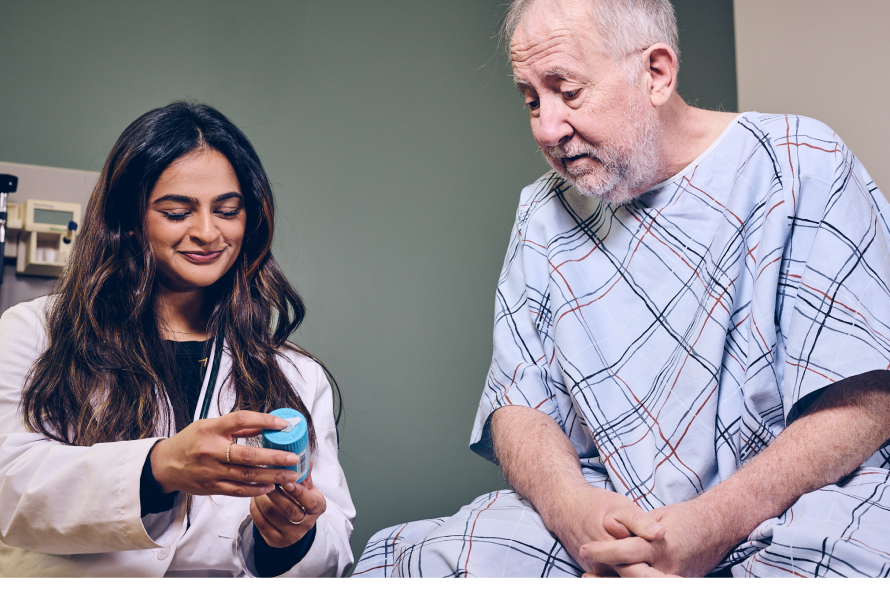
Standardized patients use their acting skills, as well as their observation skills, in ways that spark thought and self-discovery for students. “We train SPs to help the students unpack what they were thinking and feeling, so they can reflect and improve through repetition and feedback,” Mr. Krebsbach says. “SPs provide the patient perspective and essential human element to medical education that technology can’t replicate.”